
KinderKronicle Preview:
Authority Stage
Preview Month 22, Month 48, and Month 60 of KinderKronicle
Month 22
As you head into your child’s 22nd month, you are entering the next stage of parenting: The Authority Stage. Because this stage requires specific skills and a greater understanding of what “parental authority” really entails, this issue of KinderKronicle focuses entirely on this concept of authority.
For the past 22 months you have been in the Nurturing Stage. When your child utters her first “no,” that is your signal that change is on the horizon. You are now entering the third stage—The Authority Stage.

Intro into the Authority State
Month 22: Ready for Graduation?
We’ve been together for 22 months now. Your toddler is getting into everything! For him, its high adventure in more ways than one. Grandma has had to put all the breakable things up high when he visits. There are plugs in the electrical outlets, gates at the top of the stairs, and kitchen cabinet thing-a-ma-jigs on the knobs so he can’t open the doors and empty the contents.
And, he keeps saying “NO!”
Yes, graduation is just around the corner—for YOU!
You, as a parent, are entering what is identified as the Authority Stage of parenting. I call it the “who is the boss stage.” KinderKronicle Month 22 discusses the transition parents should make upon graduating from the Nurturing Stage to the Authority Stage. Maybe you ought to give yourself a graduation party!
Read More
Your 2nd Stage of Parenthood
The Six Stages of Parenting research undertaken by Ellen Galinsky has a second definition for the Authority Stage. She points out that,
“Becoming an authority for most is a process of making mistakes and rectifying them.”
Your understanding of this transition is, in my opinion, critically important, and so the entire Month 22 issue discusses ideas for your consideration as you enter the Authority Stage of parenthood. I hope that you will find the ideas and information useful—and that you will keep this issue handy to reread periodically as your child enters the so-called terrible twos. If you adapt to the transition smoothly, life should be easier.
Wishing you good luck,

P.S. Check your email to access the full screen version of this month’s KinderKronicle.
Copyright © 2008-2022 All Rights Reserved World Peace Parents Foundation.

Six Stages of Parenthood Recap
“Becoming an authority for most is a process of making mistakes and rectifying them.”
–Ellen Galinsky, “The Six Stages of Parenthood”
As you head into your child’s 22nd month, you are entering the next stage of parenting: The Authority Stage. Because this stage requires specific skills and a greater understanding of what “parental authority” really entails, this issue of KinderKronicle focuses entirely on this concept of authority.
As a brief recap, Ellen Galinsky’s Six Stages of Parenthood are:
Read More
Stage 1: The Image-Making Stage: During pregnancy, parents “form and re-form images” of the upcoming birth and the changes they anticipate. This is a period of preparation.
Stage 2: The Nurturing Stage: Parents compare image and actual experience during the time from baby’s birth to toddler’s first use of the word “no” (about age 18 to 24 months). This is a period of attachment and also of questioning. Parents may question their priorities and also how they spend their time.
Stage 3: The Authority Stage: When the child is between 2 years and 4 – 5 years, parents decide “what kind of authority to be.” This is a period of developing and setting rules, as well as enforcing them. With this Month 22 issue of KinderKronicle, and with Months 23 and 24, we will review ideas to help you add “authority,” compatible with your child’s continued need to be nurtured, to your parenting.
Stage 4: The Interpretive Stage: The Interpretive Stage starts around the time your child begins school and ends as your child approaches adolescence. In this stage, parents figure out how they want to interpret reality for their children and more firmly decide on the values they want to promote.
Stage 5: The Interdependent Stage: The Interdependent Stage begins as your child enters adolescence and lasts throughout the child’s teenage years. This stage involves a lot of the same issues as in the Authority stage, reworked to fit the older child’s needs.
Stage 6: The Departure Stage: The Departure Stage happens when the child leaves home and is usually a time when parents evaluate how their parenting has been and what successes and failures they’ve had.
Six Stages of Parenthood Recap
“Becoming an authority for most is a process of making mistakes and rectifying them.”
–Ellen Galinsky, “The Six Stages of Parenthood”
As you head into your child’s 22nd month, you are entering the next stage of parenting: The Authority Stage. Because this stage requires specific skills and a greater understanding of what “parental authority” really entails, this issue of KinderKronicle focuses entirely on this concept of authority.
As a brief recap, Ellen Galinsky’s Six Stages of Parenthood are:
Read More
Stage 1: The Image-Making Stage: During pregnancy, parents “form and re-form images” of the upcoming birth and the changes they anticipate. This is a period of preparation.
Stage 2: The Nurturing Stage: Parents compare image and actual experience during the time from baby’s birth to toddler’s first use of the word “no” (about age 18 to 24 months). This is a period of attachment and also of questioning. Parents may question their priorities and also how they spend their time.
Stage 3: The Authority Stage: When the child is between 2 years and 4 – 5 years, parents decide “what kind of authority to be.” This is a period of developing and setting rules, as well as enforcing them. With this Month 22 issue of KinderKronicle, and with Months 23 and 24, we will review ideas to help you add “authority,” compatible with your child’s continued need to be nurtured, to your parenting.
Stage 4: The Interpretive Stage: The Interpretive Stage starts around the time your child begins school and ends as your child approaches adolescence. In this stage, parents figure out how they want to interpret reality for their children and more firmly decide on the values they want to promote.
Stage 5: The Interdependent Stage: The Interdependent Stage begins as your child enters adolescence and lasts throughout the child’s teenage years. This stage involves a lot of the same issues as in the Authority stage, reworked to fit the older child’s needs.
Stage 6: The Departure Stage: The Departure Stage happens when the child leaves home and is usually a time when parents evaluate how their parenting has been and what successes and failures they’ve had.

The Authority Stage of Parenting
For the past 22 months you have been in the Nurturing Stage. When your child utters her first “no,” that is your signal that change is on the horizon. You are now entering the next stage of parenthood—The Authority Stage.
According to Ellen Galinsky, the Authority Stage is the time when the parent must “[accept] his or her authority over the child,”1 as the leader of the family. This is important and worth repeating because it is a change that you, as the parent, must make. You must accept that you are the leader of your child and family.
Galinsky points out that all parents have ideas on how parenting “should” be, gathered from their experiences, from observing others in their community, and from their personal and cultural ideals, whether or not they realize they have these expectations.
Read More
The task, then, is to identify the expectations you have about authority and parenting, and then decide which ones work for you, and which ones need to be changed or abandoned to fit real life. As you do this, you are better able to face problems “consciously and deliberately” rather than “muddling through, day by day, situation by situation.”2 You are able to be parent leaders, and the authority in your home.
Galinsky suggests that there are three steps that will help you become the authority in the home and in your child’s life:
Step # 1: Establish family rules to govern your child and yourselves as the parents.
Step #2: Communicate with your child the family rules that apply to him.
Step #3: Enforce the family rules with consistency.
| For ease of reference and identity, let’s call it the “ECE” formula: Establish, Communicate, and Enforce. |
LET’S TALK A BIT ABOUT EACH STEP.
Step #1: Establish family rules
As your child becomes more independent, more mobile, and more curious about the world around him, it becomes imperative to have limits and boundaries, clearly explained. In other words, family rules. You, as the parent, are establishing yourself as the authority that makes and enforces the limits and boundaries—the rules.
The child who comes to understand rules and boundaries within the same environment where she is loved and nurtured will be more receptive of your parenting authority. Keep in mind that if she is raised in a home without boundaries, the world outside the home can be scary and dangerous for her. Why? Because a child who has not been taught authority, rules, and boundaries in the home has no way of knowing what is acceptable and what is not outside the home.
On the other hand, boundaries that are too limiting don’t allow your child to grow and learn. As with so much of parenting, it is a balancing act. KinderKronicle will continue to discuss authority, boundaries, rules and discipline, coupled with nurturing, in future issues.
Step #2: Communicate with your child the family rules that apply to him.
Galinsky gives the following examples: “Is the child told what to do? Is the child told the reasons behind the limit, or is only the limit itself stated? In what tone of voice?3
For example, do you use a commanding, or even angry, voice to say “You will do what I say!” Or, do you calmly and kindly state the limit or rule? For example, “Jimmy, balls are for outside. We can play with the ball outside, or we can play something else inside.”
When do you communicate your rules? Do you tell your child what his limits are before a problem occurs, or are your rules created in the moment, when a stressful situation or problem is already happening?
In future issues, KinderKronicle will discuss ways to effectively communicate with a two-year-old. We will also explain how the communication style you adopt affects your child. For example, next month’s KinderKronicle will discuss the four basic “parenting disciplines,” which are authoritative, authoritarian, permissive, and uninvolved. Each of these disciplines includes a different way of communicating expectations to children. KinderKronicle advocates for authoritative parenting, and we will discuss “why” in Month 23.
Step # 3: Enforce the family rules with consistency.
As Galinsky says, “Ultimately, this means, what happens when the child loses control? And what happens when the parent feels like losing control?”4 “How do you help your child learn to deal with frustration when it occurs?”5
This step deals with the child’s, and parents’, choices and consequences:
- How do you want your child to learn from her mistakes?
- How will you react when your child tests her limits?
- What is your goal in the consequence you choose?
- Will you be consistent?
- How strongly do you want to enforce the rules you have set?
- Are you making sure to connect with your child, to show your love even when corrections to behavior are necessary?
- Galinsky, Ellen. The Six Stages of Parenthood. Reading, MA: Addison-Wesley Pub., 1987. Print. Pg. 120.
- Ibid. pg. 135
- Ibid. pg. 135-136
- Ibid. pg. 136
- Ibid. pg. 165

Authority: Making it Work
Now that we have explained the basics of Galinsky’s ECE formula, the question is “now what?” How do you make it work in your day-to-day living? Galinsky suggests several ideas to help parents to achieve the ECE steps. Here are three of the ideas she recommends:
1. Work to understand your child.1 What are his actions telling you? For example, is your child dealing with big emotions he doesn’t understand? Is he hurt, mad, scared, tired, hungry, testing boundaries, or feeling lost? Is he asking for affection or attention, or is he experimenting with a new skill or idea?
Often, a child this age doesn’t have the words or understanding to convey the real problem, so it’s important to try to see the situation from the child’s point of view. You are better able to establish useful rules and communicate them effectively if you understand your child’s needs, and you are better able to enforce the rules in an effective way, as well.
Read More
One of the reasons KinderKronicle includes the “Baby Chatter” and “Child Chatter” articles on a regular basis is because they help you understand your child’s behavior better from a developmental viewpoint.

When you can understand possible reasons for a particular behavior, it helps you to problem-solve and figure out how to help your child behave and communicate in more acceptable ways. For example, a two-year-old that hits isn’t “bad”—she just needs to be taught how to communicate frustration in a better way.
2. “Avoid Battles of Will.”2 Galinsky points out that you don’t have to exert control all the time, and you don’t have to always give in, either—that it is possible to find middle ground.
For example, assume it is time to leave the park, but your child doesn’t want to go. You might change the focus from leaving to giving a choice about the next activity. Instead of saying “Sorry, Tommy, it’s time to go,” you might say “Okay, Tommy, it’s time to go eat lunch! Would you like a peanut butter sandwich, or a ham and cheese sandwich?”
Now, that doesn’t mean it will always be a breeze to leave. In that case, “Tommy” could either suggest a third acceptable lunch option, or you might say “I’m sorry you can’t keep playing at the park. If I could, I’d let you play all day long. That would be so fun! But right now, it’s time for lunch. You can choose one of the foods I offered, or I can choose.” This way, you are giving your child choices that are acceptable for both of you, you are empathizing with him, and you are avoiding a battle of will.3
3. Change as the Child Changes.4 What works one day doesn’t always work the next, because children are always changing. As Galinsky’s statement at the beginning of this article points out, learning how to effectively exercise parental authority is, for most parents, a process of making mistakes and rectifying them.
The important thing is to be flexible, and willing to try and try again as you work to figure out what your rules are, how you want to communicate with your child, and how you will enforce your rules in such a way that your child learns and grows in an environment of understanding and love.

Learning how to exercise the right degree of authority is essential in becoming an effective family leader. As you learn, you’ll wonder how much is too much, and how much is too little? When should you let things go, and when should you hold firm? It’s definitely a lot to think about and process.
Because it’s a learning process and because it is so important, KinderKronicle will return to the subject of “authority” frequently during the next three years with ideas to help you grow into your role as the family authority in your home. Remember: it is your job to lovingly establish your family rules, communicate them to your child, and enforce them to help your child learn and grow.
- Galinsky, Ellen. The Six Stages of Parenthood. Reading, MA: Addison-Wesley Pub., 1987. Print. Pg. 120.
- Ibid. pg. 144
- Faber, Adele, Elaine Mazlish, Kimberly Ann Coe, and Joanna Faber. How to Talk so Kids Will Listen & Listen so Kids Will Talk. New York: Scribner, 1980. Print.
- Galinsky, Ellen. The Six Stages of Parenthood. Reading, MA: Addison-Wesley Pub., 1987. Print. pg. 144
Copyright © 2008-2022 All Rights Reserved World Peace Parents Foundation.
Month 48
KinderKronicle talks a lot about the parental relationship. Why? Because study after study confirms that a stable marriage relationship gives parents and their children their best chance for a productive, stable family.
Parents who have a happy, compatible relationship have less stress in their marriage and are better able to devote time and energy to their parenting. And when Mom and Dad take time to nourish and strengthen their relationship, they have a better chance of staying connected and strong together after their children are grown and have moved on to create their own families.

Change is Coming
A Note from Vibert Kesler:
As KinderKronicle and your child begin their 5th year, a big parenting change is just around the corner. The Nurturing and Authority Stages of parenting will soon “meld” into the next stage of parenting, known as the Interpretive Stage. The Interpretive Stage begins when your child starts school and ends when your child approaches adolescence. The added parenting tasks for the Interpretive Stage are:
- To understand how you want to interpret reality for your child, and
- How and when to teach the values and virtues you want to promote.
During the Interpretive Stage of parenting, KinderKronicle will frequently advocate for:
- Dad/Mom unity—Parental unity is important because it is natural for children to campaign for what they want, and if parents are not on the same page, children will exploit parental division.
- Holding weekly Family Hours—It is my experience that a weekly Family Hour is the most successful family forum for parental governance and for teaching values.

Keeping Your Marriage Dynamic
KinderKronicle talks a lot about the parental relationship. Why? Because study after study confirms that a stable marriage relationship gives parents and their children their best chance for a productive, stable family.
Parents who have a happy, compatible relationship have less stress in their marriage and are better able to devote time and energy to their parenting. And when Mom and Dad take time to nourish and strengthen their relationship, they have a better chance of staying connected and strong together after their children are grown and have moved on to create their own families.
Cohabitating moms and dads can also have a happy, compatible relationship leading to a productive, stable family. However, studies show that “only one out of three children born to cohabitating parents remains in a stable family through age 12, in contrast to nearly three out of four children born to married parents.”1
Read More
Further, “children born to cohabitating parents experience nearly three times as many family transitions…[and] have fewer economic resources than do children in married parent families.”2 Interestingly, studies show that when cohabitating couples solemnize their relationship by getting married, their relationships are often strengthened and become more long-term. Commitment is an essential element to a healthy, long-term Mom/Dad relationship.
So, with all the demands on your time and energy every day, what are some ways to keep your marriage dynamic? Here are some recommendations:
- Spend time every day reconnecting with each other and having personal time together—just the two of you. It doesn’t have to be a long time—even fifteen minutes a day can really boost your relationship. If you are a parent or a family of faith, pray together.
- Help both parents feel connected to each other and the children. Children take a lot of time and energy—when you are both feeling connected to each other and your children, when you feel like a team, your relationship is strengthened.


Here are some other ideas for how to keep your marriage dynamic, with both parents feeling valued in the relationship:
- Pay attention to the small things—The nice things you do for each other every day build love and trust between you. This could be anything from kissing each other goodbye and hello every day, to making sure your spouse’s windshield is always cleared off after a snowfall, to fixing breakfast for your spouse every Saturday. Daily demonstrations of love are very meaningful and help keep a relationship strong.4
- Limit screen time—just like your relationship with your children, your relationship with your spouse needs to have time and effort put into it if it is going to flourish. Having a “no screen time” policy during your time together can encourage the two of you to really connect with each other—to look at each other and to talk to each other when it is “couple time.”5
- Be willing to think positively about your spouse—it can be easy to translate “He’s being short with me” into “Our marriage is in trouble,” even if the situation is more like “He’s had a bad day and not handling it well.” Or “She’s nagging me” when the situation is “She’s frustrated that I’m not listening and isn’t sure how to get through to me.”When couples are willing to assume the best about each other and listen to the other, many small frustrations can be worked out in a satisfactory manner for both sides.
- Communicate with each other on a regular basis—and not just about work, or the kids. What drew you together in the first place? Is there a hobby or activity you both enjoy? People change and grow all the time—so if you want to keep your marriage dynamic and strong, it is a good idea to nurture your relationship so that you are changing and growing together.
- Have a weekly date night. During your courting stage you were probably creative on a tight budget. Keep it up.
If babysitters or money are scarce, just setting aside a specific “date” time can help. If you can’t go out to an event or dinner together, play a two-person board game, cuddle on the couch together after the kids have gone to bed, or watch a movie on the TV together. You could even take turns reading a book to each other, or put on some music and dance together. Anything that gives you focused time to spend happily together can make for a good date night.
The Mom-Dad relationship is a big part of a stable, happy, productive family. Taking the time to nourish your relationship is worth the effort.
- Manning, Wendy D. “Cohabitation and Child Wellbeing.” The Future of Children, vol. 25, no. 2, 2015, pp. 51–66., doi:10.1353/foc.2015.0012.
- Ibid.
- https://jitp.info/files/months-57-58.pdf
- https://www.care.com/c/stories/5060/5-ways-to-keep-your-relationship-strong-af/
- Ibid.
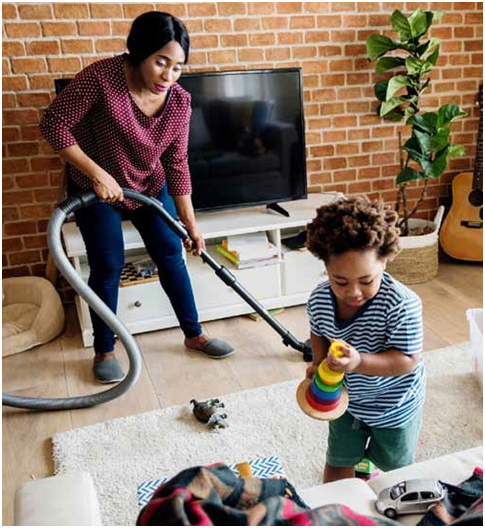
Revisiting the ECE Formula for Family Rules
As the parents of a 48-month-old, you are still in the Authority Stage of Parenting. As we discussed in Month 22 of KinderKronicle, the Authority Stage is the time when you must “[accept your] authority over [your] child” as the leader in your home.1
This doesn’t mean you need to be a harsh dictator (remember, KinderKronicle recommends the Authoritative style of parenting—see Month 23), but it does mean that you are the one to set the limits and boundaries in your home.
The ECE formula for family rules we introduced in Month 22 of KinderKronicle is how parents set and enforce the family rules.
As a reminder, the ECE formula has three steps:
Read More
Step 1: Establish family rules.
Step 2: Communicate the family rules clearly to each member of the family, so everyone understands what is expected of them.
Step 3: Enforce the family rules with consistency.
As your child grows and matures, and as his needs change, the family rules will need to be revised or clarified. Family Hour is a great time to discuss any needed adjustments with everyone in the family— because when everyone has input into the rules, everyone is more invested in abiding by them. Remember, your parenting has to grow up with your child if you want it to be effective.
Family Hour is also a great time to make sure everyone is clear on the rules, and understands the consequences of breaking family rules. Talking about potentially difficult issues is always much easier when you are calm, happy, and enjoying each other’s company.
The third step of the ECE formula is especially important. It doesn’t do a lot of good to have rules if they aren’t enforced. Consistency is important.
Children thrive when they understand where the boundaries are and when they know that you are there to help them learn and grow within reasonable boundaries. When the rules are consistently enforced, your child quickly learns which rules and boundaries are firm ones and which boundaries are more flexible.
Your child is quickly heading toward school age, which is when the “Interpretive Stage” of parenting begins. Taking the time to build a strong foundation of love, reasonable limits and boundaries, and consistent follow-through now will help you to keep your family strong as outside influences begin to factor more heavily into your child’s life.
- Galinsky, Ellen. The Six Stages of Parenthood. Reading, MA: Addison-Wesley Pub, 1987. Print.

Solve: The Fifth Core Principle
“The key to marital happiness is not to rid the relationship of differences: we ignore some, tolerate others, laugh about our humanness, and discuss those things we can do to work better together.” – H. Wallace Goddard
So far, KinderKronicle has discussed the Dad Difference principles of “Commitment,” “Growth,” “Understand,” and “Nurture.” This month, we will focus on the principle of “Solve.”
H. Wallace Goddard says that “the assumption that, if we can only talk about our problems effectively, we will have a good relationship… may have caused more marital mischief than any other idea in the history of relationships.”1 He points out that this approach “can at times keep partners focused on their discontents.”
Instead, he believes that being willing to “accept some differences and allow for them as a continuing part of the relationship” is more likely to help strengthen your relationship and solve many problems.2
He also suggests the following when working with your spouse to solve problems that arise: 3
Read More
- Stay calm in the face of differences:
Even if you and your spouse are united in purpose and in your goals, there are going to be many times when you may have different approaches to situations or react in different ways. If you approach potential problems as a team, with a willingness to assume the best of each other, resolving issues becomes easier and less stressful for both of you. - Be open to other views:
Your spouse may approach tasks and problems differently than you do. When you are willing to be open to other views, you can learn from each other and grow together. - Consider multiple courses of action:
There are often many different good ways to deal with problems that arise in relationships. Be willing to brainstorm ideas together to find solutions that work for both of you.For example, are you both satisfied with the division of labor in your home? Is each spouse given the “space” they need to carry out their agreed-upon tasks without nitpicking from the other? - Accept some differences as a part of the relationships:
You and your spouse aren’t going to agree on every issue, you aren’t going to approach every situation in the same way, and you are going to differ on many topics. This is not only okay, but a good thing—it brings variety and strength to your relationship, if you let it, because you can fill in gaps for each other and multiple perspectives can enrich your home. You only need to learn to work together and be ok with each other’s differences. - Allow time for changes:
When issues do arise, remember that change doesn’t occur overnight. It takes time to learn new skills or new patterns of behavior, so patience with each other and loving support for each other are vital if real change is going to occur.
- Goddard, H. Wallace. “Better Marriages Make for Better Fathering.” Why Fathers Count. Harriman, TN: Men’s Studies Press, 2007. 59-75. Print.
- Ibid.
- Ibid.
Copyright © 2008-2022 All Rights Reserved World Peace Parents Foundation.
Month 60
In Month 60, you are entering a time of major adjustment where you need to start thinking deeply about how to interpret the world to your child.
In Month 59, we briefly reviewed the six stages of parenthood and introduced you to six major decisions facing parents as you enter the Interpretive Stage of Parenting. We made these three dominant points for your consideration:
– As a parent, how do you intend to interpret the outside world to your child?
– Do you understand the world through the lens of truth or relativism? KinderKronicle presents its information as truth.
– It is essential that you listen—really listen—to your child, your spouse, and other family members to get a feel for how to approach interpreting your values.

Welcome to the Interpretive Stage of Parenting
Ellen Galinsky, author of The Six Stages of Parenthood, points out that parenthood often “follows a pattern: periods of harmony, of getting along with each child, followed by periods of disharmony when [you] and the child are out of synch.”1
The times of disharmony often herald new phases of growth, and can be indications that the child “needs different things…and we [as parents need to] adjust.”2
In Month 60, you are entering a time of major adjustment where you need to start thinking deeply about how to interpret the world to your child.
Read More
In Month 59, we briefly reviewed the six stages of parenthood and introduced you to six major decisions facing parents as you enter the Interpretive Stage of Parenting. We made these three dominant points for your consideration:
- As a parent, how do you intend to interpret the outside world to your child?
- Do you understand the world through the lens of truth or relativism? KinderKronicle presents its information as truth.
- It is essential that you listen—really listen—to your child, your spouse, and other family members to get a feel for how to approach interpreting your values.
As a reminder, this stage begins about age five (it’s usually triggered by the start of schooling) and ends as your child approaches adolescence. In other words, the Interpretive Stage of parenthood lasts for about 96 months. In this stage, parents “figure out how they want to interpret reality for their children and more firmly decide on the [family and personal] values they want to promote.”3
The first step in approaching this stage is to clarify in your own mind what your personal and family values are and what values, virtues, and character traits you want to focus on in your home.
For example, if you value honesty, empathy, friendliness, kindness, or other such virtues, these are the traits and virtues you should be focusing on in your home. A primary parenting task for the Interpretive Stage is to instill such virtues in your child to guard against unwanted outside influences. We will discuss more about virtue guards beginning in Month 72.
As you gear up to enter this new stage of parenthood, it is beneficial to evaluate how your parenting journey has gone so far as you prepare to deal with new challenges and changes. You might ask yourself questions like:
- “What has been working well in our family?”
- “What challenges am I having as a parent?”
- “What do I wish I would do differently?”
- “How frequently is my parenting matching with my ideal?”
- “What outside-the-home organizational environments do I want to surround my child with?”
Asking yourself these types of questions helps you to decide how things are going in your family, so you can keep the things that are going well and find ways to tweak your parenting in things that aren’t going as smoothly as you’d like.
- Galinsky, Ellen. The Six Stages of Parenthood. Da Capo Press, 1987.
- Ibid.
- Ibid.

Interpreting Oneself as a Parent
As stated previously, before you can effectively interpret the outside world to your child, you must give thought to Interpreting oneself as a parent. This is true for both Mom and Dad. According to Galinsky, this task has three parts:
FIRST, it means that you come to understand yourself better as a parent (you know how you generally react and act, you know what you’re good at, parenting-wise, and you know where your actions don’t match up to your idea of “good parenting.”)1 When you identify what aspects of parenting you are good at, and what parenting traits you need to continue working on as a parent, you are more self-aware, and more likely to be more patient with both yourself and your child as you try and try again to follow the principles that you hold dear.
Read More
SECOND, you decide “consciously or not, how [you] want to behave toward [your] children, and similarly how [you] want to interpret [yourselves] to your children.”2 In other words, parents in the Interpretive Stage think about how they come across to their children, and whether they are making a good impression on their children. As author Robert Fulghum said, “Don’t worry that children never listen to you; worry that they are always watching you.”
Entering the Interpretive Stage is a time of reflection, ideally accompanied by action, which helps parents be the people they want their children to see them as. Leading by example is the best way to instill positive growth and change and knowledge in your children.
When it comes to your personal character traits, do they reflect what you want your child to become?
THIRD, parents often must walk a fine line between sharing information and withholding it, based on the age and maturity of the child, along with the seriousness of the subject.
For example, if a parent has a bad day at work, their child can sense it, and if the parent doesn’t share anything, the child may think he had something to do with it. But if the parent shares too much, it may be too much for the child to handle.
This delicate balance of sharing and withholding can be difficult, but as you decide, over and over again, what you will share or not, and how you will share information, it helps you refine how you view yourselves as parents and how you want to approach parenting your child in many different situations.
It is also important for Mom and Dad to be united as parents. If you are not on the same page regarding what values to teach your children, or how to approach serious topics, or how much and in what way information should be shared, your important messages and teachings for your child can get lost in power struggles. Then everyone loses.
For this reason, communication—between Dad and Mom as well as between you and your children—is very important. Agreeing on a unified message helps you as parents to clearly demonstrate and teach the values and virtues that are most dear to your family as a whole.
Communication is also vital as you teach principles of independence to your child. Both parent and child do a lot of “growing up” during the Interpretive Stage. The principles and values you introduce and encourage in the Interpretive Stage end up being refined and reinforced in the Interdependent Stage (the child’s teenage years). Future issues of KinderKronicle will discuss ways to teach independence in loving, responsible ways to help you along this journey.
The Interpretive Stage is a long and important one. There are a lot of things parents need to do during this stage of parenting, but you can do it. When you take time to reflect regularly on how you are doing, and whether you are matching your actions to your stated ideals, you can better keep you, your child, and your family on track.
- Galinsky, Ellen. The Six Stages of Parenthood. Da Capo Press, 1987.
- Ibid.
We like that the Program is simple and easy to use. I also appreciate the direct teaching ideas of how to be an effective parent. It is great to get a reminder of the principles each month in KinderKronicle. I really appreciate the assistance I have been given as a parent.
Enroll in Begin with the Children
Parents expecting the birth of a child as well as parents of young children are welcome to enroll in our free monthly Begin with the Children program.
Enroll to receive the study course on our app


Enroll to receive the program via email